
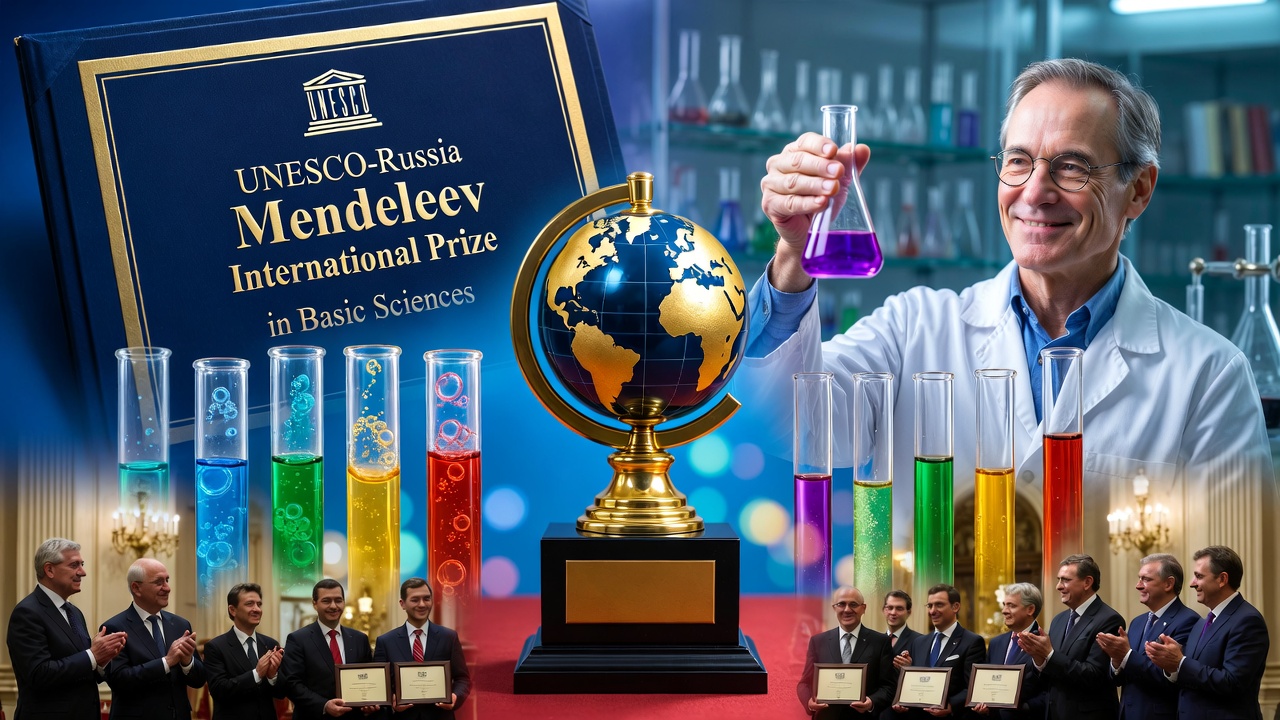
If you’re a scientist who is basically the “Dmitry Mendeleev” of your generation, or you know a researcher whose work is literally rewriting the textbooks, the UNESCO-Russia Mendeleev International Prize 2026 is the pinnacle of recognition. With a staggering prize fund of $500,000, it is one of the most significant awards in the global scientific community.
Named after the father of the Periodic Table, this prize isn’t for incremental progress; it’s for “Breakthrough Discoveries” that drive socio-economic transformation across Chemistry, Physics, Mathematics, and Biology.
Important Dates (The 4th Edition)
The clock is ticking. Since today is February 26, 2026, you have exactly 17 days left before the official portal closes. However, most universities require internal review much sooner.
| Event | Deadline / Date |
| Internal University Deadlines | March 5 – 10, 2026 (Typical) |
| Official UNESCO Deadline | March 15, 2026 |
| Jury Deliberation | Mid-2026 |
| Award Ceremony | Late 2026 (Paris/Moscow) |
The Prize: What’s on the Table?
Every year, UNESCO selects two extraordinary winners. Each laureate receives a package that would make even a Nobel winner do a double-take:
-
💰 $250,000 USD in cash.
-
🥇 A Gold Medal.
-
📜 A Formal Diploma of excellence.
3. Eligibility: Who Can Be the Next Laureate?
The prize looks for individuals whose work has had a “significant transformational impact” on a regional or global level.
-
The Four Pillars: Research must be in Chemistry, Physics, Mathematics, or Biology.
-
Impact Over Age: There is no age limit. Whether you are a veteran researcher or a younger prodigy, your “impact” is the only currency.
-
Gender Priority: In line with UNESCO’s Global Priorities, nominations of women scientists are strongly encouraged to ensure a diverse representation of excellence.
How to Nominate (The “No Self-Nomination” Rule)
You cannot simply “apply” for this prize. You must be nominated by an authorized entity.
-
Authorized Nominators include:
-
Governments of Member States (via National Commissions for UNESCO).
-
Non-governmental organizations (NGOs) in official partnership with UNESCO.
-
UNESCO Chairs and Category 2 Centres.
-
International scientific unions.
-
Accredited Universities and research institutions.
-
-
The Portal: All dossiers must be submitted through the official UNESCO online template in either English or French.
Why This Prize is a “Career Legend” Maker
Most awards look at your past citations; Mendeleev looks at the future. The jury—which includes eminent scientists like Krishna N. Ganesh and Farida Fassi—assesses how your research aligns with the UN 2030 Agenda for Sustainable Development.
If your work in Molecular Science or High-Energy Physics is helping solve climate change, energy poverty, or global health crises, you are exactly the type of “Architect of Discovery” they want to honor.
Pro-Tips for a Winning Nomination:
-
Evidence of Popularization: Don’t just list your lab results. Show how you’ve helped “popularize” basic science. Have you written books? Led international collaborations? Mentored hundreds of students?
-
The “Mendeleev” Spirit: The periodic table succeeded because it was a universal language. Highlight how your research fosters international cooperation.
-
Institutional Coordination: Because the deadline is March 15, you must contact your University’s Vice-Rector of Research or your National Commission this week to ensure they have time to endorse your file.