
In January 2026, Rotary officially opened a brand-new Peace Center at Symbiosis International University in Pune, India. And honestly, that’s a huge deal. Especially for mid-career professionals in South Asia who maybe couldn’t relocate far away before.
For the first time, there’s a dedicated hub in the region focusing on peacebuilding from a South Asian perspective. That changes things. A lot.
If you’ve been thinking about applying for the Rotary Peace Fellowship, this might actually be your year.
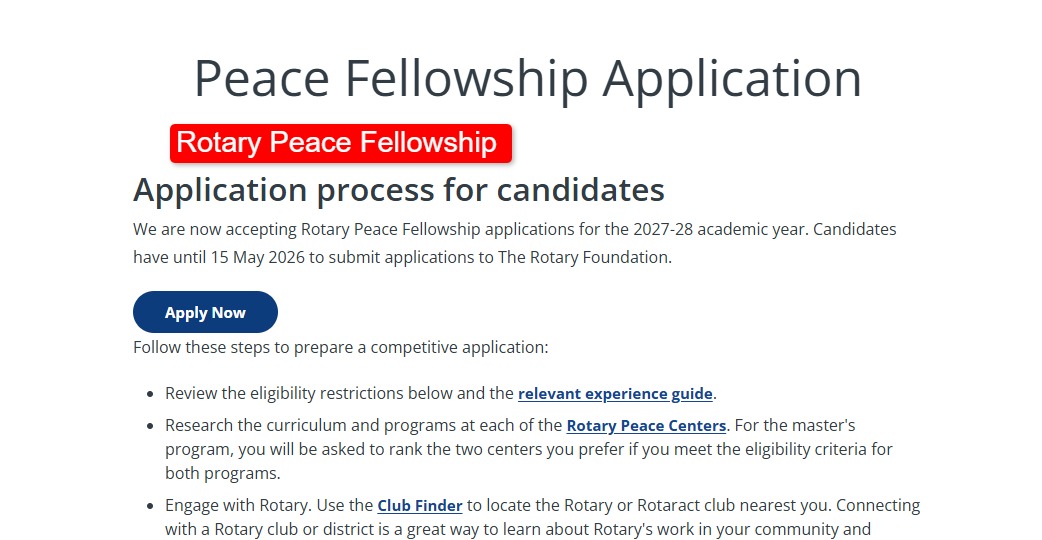
Important Dates
The application window is already OPEN. And Rotary is very serious about deadlines. Like… very.
-
Application Opened: February 1, 2026
-
Application Deadline: May 15, 2026
-
Selection Results: November 2026
-
Program Start: Mid-to-late 2027
And quick advice? Don’t wait until May 14. You can, technically… but you shouldn’t.
If you’re planning to connect with a local Rotary club for endorsement (it’s optional, but highly recommended), that takes time. You might need meetings, interviews, conversations. It’s not instant.
Start early. Future you will be thankful.
Two Paths – Which One Makes Sense for You?
Rotary offers two different tracks, depending on where you are in your career.
And choosing the right one matters.
1. Master’s Degree Program (Early-Career Professionals)
Duration: 15–24 months
Experience Required: At least 3 years of relevant work or volunteer experience
You could study at universities like:
-
Duke/UNC (USA)
-
University of Bradford (UK)
-
International Christian University (Japan)
-
University of Queensland (Australia)
-
Uppsala University (Sweden)
This track is more academic. Structured. Research-oriented. It’s great if you’re still building your foundation in peace and development work.
2. Professional Development Certificate (Mid-Career Leaders)
Duration: 1 year (includes online learning + 11 weeks on-site)
Experience Required: Minimum 5 years
Centers include:
-
Makerere University (Uganda)
-
Bahçeşehir University (Turkey)
-
Symbiosis International University (India) – the new one
This one is practical. It’s for people already working in leadership roles who want tools they can apply immediately.
And yes, the new India center is part of this track — which makes it super interesting for regional professionals.
Eligibility
You don’t need to be a genius. But you do need to show leadership and real commitment.
Basic requirements:
-
Bachelor’s degree
-
Strong English proficiency
-
Proven experience in peace, development, or conflict-related work
-
Cannot be an active Rotary member
There’s also something people call the “Rotary gap.” If you recently resigned from Rotary, usually there’s a 3-year waiting period before you can apply. So double-check that if it applies to you.
How to Make Your Application Strong
This is where most people get stuck. Rotary Peace Fellowships
1. Don’t Write a Robotic Statement
The reviewers see thousands of resumes. They don’t need another one.
Tell them why you care about peace work. Was there a moment that changed you? A project that failed but taught you something? That’s what makes your application human.
2. Be Specific
If you’re applying for the certificate track, you’ll need a Social Change Initiative idea. Make it concrete.
Not: “I want to promote harmony.”
But: “I want to create mediation workshops for youth in X district affected by Y conflict.”
Specific beats vague. Every time.
3. Talk to a Local Rotary Club
This step is underrated.
Reach out politely. Introduce yourself. Share your goals. Even if you don’t get formal endorsement, the guidance alone can help refine your application.
Why 2026 Feels Different
The expansion into Asia isn’t just symbolic. It shows Rotary is investing in regional leadership instead of expecting everyone to move across the world.
For South Asian applicants especially, the Symbiosis Peace Center removes a huge barrier — financially and culturally.
It feels more inclusive now. More accessible.
The world doesn’t need more people who are only angry about problems. It needs people trained to actually build peace.
The Rotary Peace Fellowship is competitive, yes. But it’s also one of the few fully funded programs that genuinely invests in long-term leadership.
If you’re even slightly considering it, start preparing now. May 15 will come faster than you think… trust me.
And even if you don’t get selected the first time? Apply again. Many fellows did.