
If you’re an Indian scientist working abroad and dreaming of setting up your own lab back home, the Ramalingaswami Re-entry Fellowship 2026 is your ticket to independence. Managed by the Department of Biotechnology (DBT), this fellowship is designed to reverse “brain drain” by providing the funding and professional status needed to transition into the Indian academic system.
Since today is February 26, 2026, we are in the “Final Countdown.” You have exactly two days left to hit submit on the portal.
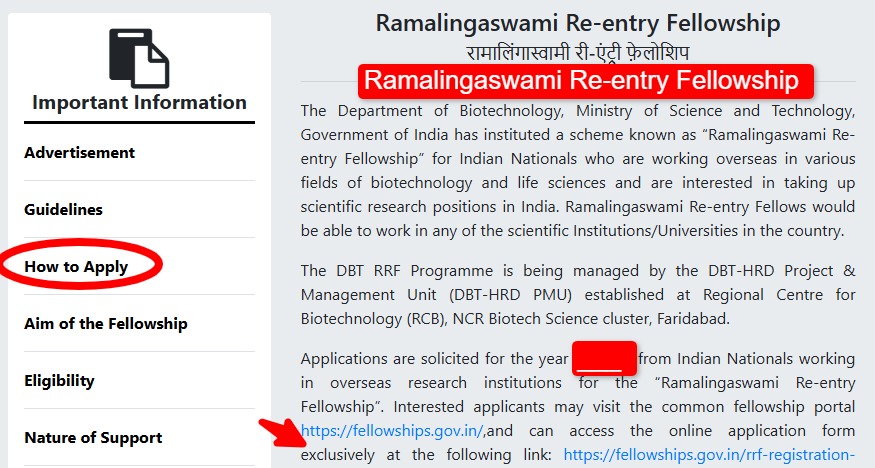
Ramalingaswami Re-entry Fellowship 2026: The “Return to India” Guide
The Deadlines (Don’t Miss This!)
The 2026 cycle is active right now. If your documents aren’t uploaded yet, this is your weekend to get it done.
-
Application Start Date: January 28, 2026
-
Final Submission Deadline: February 28, 2026
-
Expected Result Date: June / July 2026
-
Joining Window: Usually within 9 months of the award letter.
The Benefits: A “Scientist-D” Level Package
This is one of the most generous re-entry grants in India. It doesn’t just give you a salary; it gives you a lab-starting budget.
| Component | Amount (Updated for 2026) |
| Monthly Fellowship | ₹1,35,000 (Consolidated) |
| House Rent Allowance (HRA) | ₹18,500 per month |
| Research Support Grant | ₹13,00,000 per year |
| Institutional Overhead | ₹50,000 per year |
| Duration | 3 Years (Extendable up to 5) |
Eligibility: Who Can Apply?
-
Nationality: Must be an Indian National (OCI/PIO cards are not eligible).
-
Age Limit: Maximum 45 years as of February 28, 2026.
-
Qualifications: Ph.D. / M.D. or equivalent in Life Sciences, Biotech, Agriculture, or Bio-engineering.
-
Experience: Minimum 3 years of Post-doctoral experience in overseas laboratories.
-
Return Status: * If you are still abroad: You are 100% eligible.
-
If you already returned: You must have returned within one year (two years for women) and must not hold a permanent position in India.
-
How to Apply: The Portal Process
Applications are handled via the DBT RRF Portal.
-
Register: Create your ID on the eProMIS/RRF portal.
-
Host Institute: You must have a letter of support from an Indian host institution (University or Research Lab).
-
Research Proposal: This is the most weighted part of your application. It must be feasible in an Indian setting.
-
Referees: Ensure your overseas supervisors have their recommendation letters ready for upload.
Pro-Tips for a Rank #1 Application:
-
Host Commitment: DBT encourages host institutes to treat fellows as “Scientist-D” or Assistant Professor level. If your host letter explicitly mentions you can take Ph.D. students, your application looks much stronger.
-
The “India-Relevance” Factor: While your science can be global, the selection committee loves to see how your research could impact the Indian biotech ecosystem (e.g., local diseases, tropical agriculture, or affordable healthcare).
-
The “Two-Grant” Rule: You can apply for both the Ramalingaswami and the Ramanujan Fellowship simultaneously. However, you can only accept one.
-
Publication Quality: The committee favors high-impact first-author papers from your time abroad. Quality beats quantity every time here.
FAQ: What happens if I get a permanent job?
If you secure a permanent faculty position during your fellowship, your monthly salary (₹1.35L) stops, but you can keep the Research Support Grant (₹13L/year) to continue your work. This is a huge advantage for new faculty members!