
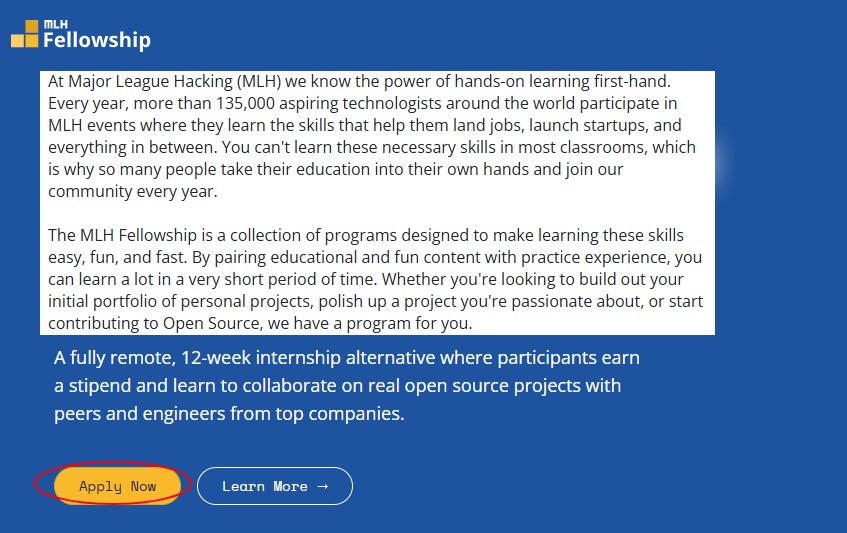
The MLH (Major League Hacking) Summer Fellowship 2026 is the most competitive cohort of the year — and for good reason. It’s a 12-week, fully remote internship alternative where you build real-world software alongside engineers and mentors. Because it aligns with university summer breaks, this batch fills fast. As of 2026, applications are officially OPEN.
If you’re searching for: MLH Fellowship Summer 2026 application deadline, start date, rolling admissions strategy, batch dates. You’re in the right place.
📅 MLH Fellowship Summer 2026 Critical Dates
Admissions are rolling — meaning they review applications as they come in and fill pods (small groups) continuously.
| Milestone | Date |
|---|---|
| Application Deadline | April 30, 2026 (11:59 PM ET) |
| Program Start Date | May 18, 2026 |
| Program End Date | August 7, 2026 |
⚠️ Why Rolling Admissions Matters
The MLH Fellowship rolling admissions strategy is simple:
Apply early or risk missing out.
For the summer batch, strong candidates typically apply by mid-March to move through interviews before the ~100-fellow capacity fills.
If you wait until late April, many pods may already be full.
🚀 Available Tracks for Summer 2026
Here’s a breakdown of all tracks — and how they differ.
1️⃣ MLH Software Engineering Fellowship Summer 2026
You’re matched with a corporate partner and work on a production-level engineering project.
Past partners have included companies like:
-
Google
-
Meta
-
Adobe
You’ll collaborate in an agile environment with code reviews, standups, and shipping cycles.
Best for: Students targeting SWE internships at FAANG or product startups.
2️⃣ Open Source Track
You contribute to high-impact open-source tools like:
-
React
-
Flask
-
Jest
-
scikit-learn
This track is closest in spirit to MLH Fellowship vs Google Summer of Code (GSoC) comparisons.
Unlike Google Summer of Code, MLH provides structured mentorship and pod-based collaboration.
Best for: Students who love open-source contribution and documentation-heavy work.
3️⃣ Production Engineering / Site Reliability
Sponsored by Meta, this track focuses on:
-
DevOps
-
Automation
-
Monitoring systems
-
Reliability at scale
If you’re comparing MLH Production Engineering Track vs Open Source Track, here’s the difference:
-
Production = Infrastructure + systems thinking
-
Open Source = Feature building + community collaboration
4️⃣ MLH Fellowship Web3 Engineering Track 2026
Focused on blockchain ecosystems like:
-
Solana
-
Polygon
Best for: Developers exploring decentralized applications and smart contracts.
💰 MLH Fellowship Stipend Amount 2026
Let’s address the most searched question:
Is MLH Fellowship paid for Indian students?
Yes.
The MLH Fellowship stipend amount 2026 India (and globally) ranges:
$1,000 – $5,000 USD
It’s:
-
Need-based
-
Adjusted for regional cost of living
-
Paid as an educational stipend
Time Commitment
If you’re searching:
-
MLH Fellowship time commitment 20 hours
-
“Is it full-time?”
Here’s the breakdown:
-
Full-time: 30–40 hours/week (Summer batch is primarily full-time)
-
Part-time: 10–20 hours/week (Limited for summer)
Fully remote — but you must attend daily standups in ET, PT, GMT, or IST.
🛠️ How to Get Selected: The Application Checklist
If you want to pass screening, your application needs three strong pillars.
1️⃣ MLH Fellowship Code Sample Requirements
This is the most important part.
Submit:
-
A GitHub repo
-
Feature-complete project
-
Clean README
-
Clear commit history
Avoid:
-
Tutorial clones
-
Basic CRUD apps without originality
When people ask for Best projects for MLH Fellowship application, strong examples include:
-
Full-stack SaaS with authentication
-
Scalable APIs with testing
-
DevOps automation tools
-
Data dashboards with real datasets
2️⃣ MLH Fellowship Technical Interview Questions 2026
If shortlisted, you’ll attend a 15-minute Code Walkthrough.
Expect:
-
“Why did you structure your backend this way?”
-
“What would you refactor if scaling to 10k users?”
-
“Explain your error-handling logic.”
You must explain every line of code you submitted.
This is what many refer to as the MLH Fellowship pod interview experience.
3️⃣ Behavioral & Essay Section
If you’re searching:
-
How to pass MLH Fellowship behavioral interview
-
MLH Fellowship application essay word limit
The essay is usually short (concise but reflective — exact word limits may vary by cycle).
Focus on:
-
Growth mindset
-
A real technical failure
-
What you learned
Don’t list technologies. Tell a story.
🎓 Eligibility: Can International Students Apply?
Yes — the MLH Fellowship eligibility for international students is open globally.
You must:
-
Be at least 18 years old
-
Be enrolled in a degree program or recent graduate
-
Have strong English communication skills
Past participants include students from India, Europe, Africa, and Latin America.
If you’re an MLH Prep program alumni fast track candidate, you may have a slight familiarity advantage — but selection is still competitive.
⏳ Hidden but Important Questions
How long does MLH Fellowship review take?
Because of rolling admissions:
-
2–4 weeks for early applicants
-
Possibly longer closer to deadline
MLH Fellowship Discord invite link?
Selected fellows receive access after onboarding.
🤔 MLH Fellowship vs Google Summer of Code (GSoC)
Quick comparison:
| MLH Fellowship | GSoC |
|---|---|
| Team-based pods | Individual contributor |
| Structured daily mentorship | Mentor-dependent |
| 12 weeks fixed | Variable length |
| Educational stipend | Project-based stipend |
If you want collaborative simulation of a tech job → MLH.
If you want deep open-source ownership → GSoC.
Final Advice: Apply Early
If you’re serious about the MLH Fellowship Summer 2026 application deadline (April 30, 2026) — don’t treat it as the real deadline.
Your real deadline is mid-March.
That’s the difference between:
-
Competing for the last pod
-
Or choosing your preferred track
If you want, I can also share:
-
A sample winning project structure
-
A mock technical interview script
-
Or a 7-day sprint plan to strengthen your GitHub before applying 🚀