
Contrary is a venture fund backed by the founders of Tesla, Reddit, and Airbnb. They don’t care about your GPA as much as they care about your “proof of work.” Whether you want to hunt for the next unicorn on campus or write the definitive memo on one, here is your 2026 guide to getting in.
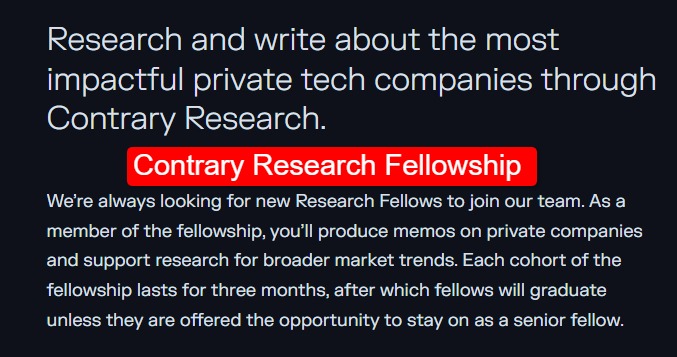
The Contrary Research Fellowship
If you prefer deep-diving into S-1 filings and private company data over networking at mixers, this is for you. This fellowship is about producing high-quality investment memos that are read by the entire tech industry.
-
Duration: 3-month cohorts.
-
The Pay: You get a cash stipend for every memo you complete.
-
2026 Application Deadlines (Mark Your Calendar!):
-
Q1 Cohort: March 25, 2026 (Deadline in 25 days!)
-
Q2 Cohort: June 17, 2026
-
Q3 Cohort: October 23, 2026
-
Q4 Cohort: December 9, 2026
-
-
The Vibe: You work with professional editors to hone your “VC voice.” It’s basically a bootcamp for future equity researchers or venture analysts.
The Venture Partner (VP) Program
This is their flagship campus-scout initiative. VPs are the “eyes and ears” on campus, identifying student founders before they even have a pitch deck.
-
2026 Schedule: Applications traditionally open in August 2026 and close mid-September.
-
The Vibe: It’s strictly for students (UG, PG, or MBA) with at least one year of school left.
-
The Catch: It is unpaid. However, the “real” pay is the network. VPs get a front-row seat to term-sheet negotiations and an annual all-expenses-paid summit in San Francisco.
-
Selection Rate: Brutal (~3%). They look for “builders”—people who have started companies, won major hackathons, or built apps with 1M+ users.
Honestly, 2026 is noisy. Everyone says they’re “passionate about AI,” “mission-driven,” and “obsessed with impact.” Recruiters read that line 200 times a day. So if you really want to stand out, you have to do something a little different.
1. Don’t Just Repeat Buzzwords
Saying “I love AI” doesn’t mean much anymore. Almost everyone does.
Instead, talk about the specific thing you actually built or explored.
Maybe you:
-
Built some strange little hardware project in your hostel room that barely worked but taught you a lot
-
Wrote a 10-page breakdown on why a hyped SaaS startup is actually struggling
-
Spent weeks reverse-engineering a product just to understand how it scales
That kind of detail makes you real. It shows curiosity. It shows you think for yourself. And honestly, that’s rare.
2. Show Proof. Don’t Just Talk.
A lot of people say they “build in public.” Few actually do.
If you’ve done the work, link it.
-
Your GitHub (with actual commits, not empty repos)
-
Your Substack essays
-
Your Twitter (X) threads where you explain ideas clearly
-
A Notion page where you documented your experiments
When someone clicks your link and sees that you’ve already been thinking, building, writing — without anyone forcing you — that’s powerful. It tells them you don’t wait for permission.
3. Think Independently (Even If It’s Unpopular)
Independent thinking is underrated.
If everyone says a company is brilliant, and you respectfully argue why their model might fail — and you back it up with data — that stands out.
Not because you’re contrarian for attention.
But because you can reason.
In 2026, original thinking is more valuable than polished language.
4. The “Eric” Interview
In the final round, you might end up in a conversation with the founder, Eric Tarczynski.
That conversation usually isn’t about memorized answers.
He looks for what some people call “slope.” That basically means:
Are you learning faster than the people around you?
Are you growing quickly, even if you didn’t start ahead?
It’s not about pedigree. It’s about trajectory.