
If you’re someone who enjoys reading about political economy at 11 PM just because it’s interesting… then you’ve probably come across the Don Lavoie Fellowship already. And if you haven’t — well, this might be your thing. The Don Lavoie Fellowship is a semester-long virtual program hosted by the Mercatus Center at George Mason University.
It’s designed for students and young professionals who want to seriously engage with the Austrian, Virginia, and Bloomington schools of political economy — without relocating anywhere. As of 2026, the application window for the 2026–2027 academic year is OPEN. Let’s break everything down properly.
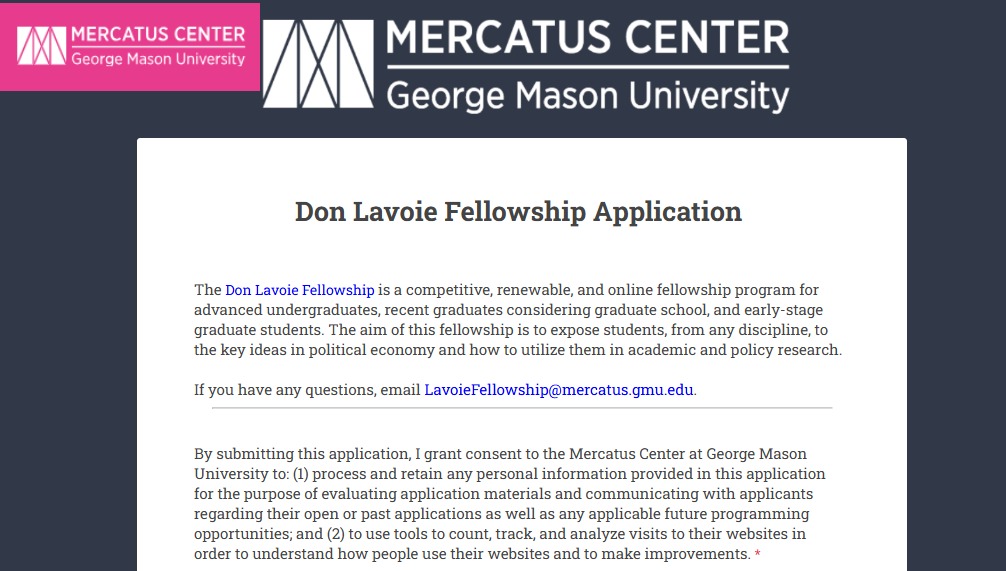
2026–2027 Cycle: Important Dates
Here’s what you need to know:
-
Applications Opened: January 2026
-
Application Deadline: April 15, 2026
-
Decision Notification: Roughly 12 weeks after deadline (Late June/July 2026)
-
Program Start: Fall 2026 (Semester-long)
So yes, if you’re waiting — don’t. April 15 will come fast.
If you’re wondering about the Don Lavoie Fellowship results date or the “Don Lavoie Fellowship 12 week notification” timeline, expect updates around late June or July.
You can usually track your Mercatus Center application status through their portal.
What Is the Don Lavoie Fellowship?
This fellowship is part of the Mercatus Center’s broader academic programs, sometimes associated with the Hayek Program in advanced study of philosophy, politics, and economics.
It’s fully online. But don’t mistake online for “easy.”
The focus is on:
-
Austrian economics
-
Virginia political economy
-
Bloomington institutional analysis
In simple words — how institutions, knowledge, and incentives shape society.
If you’ve read thinkers like:
-
F.A. Hayek
-
James Buchanan
-
Elinor Ostrom
Then you already have an idea of the intellectual direction.
If not, don’t worry. Many applicants are exploring this seriously for the first time.
Eligibility: Who Can Apply?
One good thing? It’s open globally.
Yes, the Don Lavoie Fellowship for international students is absolutely possible.
You must fit into one of these categories:
1. Advanced Undergraduate Students
If you’re considering grad school in the future.
(This covers Don Lavoie Fellowship undergraduate eligibility.)
2. Recent Graduates / Young Professionals
Those planning to pursue graduate studies.
3. Early-Stage Graduate Students
Master’s students or early PhD candidates.
You are NOT eligible if you will be enrolled at George Mason University during the fellowship year. They have separate internal programs.
And yes — this is also open to people outside economics. The Don Lavoie Fellowship for non-economics majors is common. Many fellows come from political science, philosophy, public policy, history, even STEM backgrounds.
Fellowship Benefits (2026 Details)
Let’s talk practical.
Don Lavoie Fellowship Stipend Amount 2026
Up to $1,250 total stipend
(Provided after successful completion.)
It’s not huge funding. But this fellowship is more about intellectual development than financial reward.
Other Benefits
-
All required books and readings provided
-
Academic mentorship from Mercatus scholars
-
Access to global alumni network (2,000+ fellows)
-
Career guidance for grad school
When people ask about Don Lavoie Fellowship prestige and benefits, I’d say this: in policy and political economy circles, it carries real weight.
Program Structure (100% Online)
The fellowship is designed to be rigorous but manageable alongside a job or degree.
Reading Groups
You participate in four synchronous online discussion sessions. These are part of what some refer to as the Hayek Program reading discussion sessions.
You’re expected to actually read. Not skim.
Discussion Portal
There’s a digital platform with:
-
Podcasts
-
Videos
-
Peer discussion prompts
Don Lavoie Fellowship Reading List
The reading list typically includes foundational texts from Austrian, Virginia, and Bloomington traditions — focusing on institutional analysis and knowledge problems.
If you’re curious about the Austrian Virginia and Bloomington schools of political economy, this fellowship gives structured exposure.
How to Get Don Lavoie Fellowship (Application Guide)
Now let’s talk strategy.
Here’s a mini Mercatus Center fellowship application guide for you.
Required Materials
-
Cover Letter (1–2 pages)
-
Current CV/Resume
-
Short Essay Questions
That’s it structurally. But execution matters a lot.
Don Lavoie Fellowship Cover Letter Tips
Your cover letter should:
-
Clearly explain your research interests
-
Show familiarity with political economy
-
Explain why this fellowship fits your goals
Don’t just say “I am passionate. Show intellectual curiosity. Mention specific thinkers or questions you care about.
Don Lavoie Fellowship Short Answer Responses
The short essays are very important.
They usually ask about:
-
Intellectual influences
-
Academic goals
-
What you hope to gain
Your Don Lavoie Fellowship essay examples should reflect depth, not buzzwords.. And honestly — don’t copy templates.
Is the Don Lavoie Fellowship Worth It?
Short answer: Yes, if you’re serious about political economy. It won’t magically get you into Harvard. But it strengthens your academic profile and exposes you to serious thinkers.
If you’re comparing Don Lavoie vs Frederic Bastiat Fellowship, here’s a rough idea:
-
Don Lavoie: More theory-heavy, reading intensive
-
Bastiat: More policy-oriented and competitive
Both are respected. But Don Lavoie is often considered more foundational.
Common Mistakes to Avoid
-
Writing generic cover letters
-
Not showing familiarity with political economy
-
Treating it like just another online certificate
-
Rushing essays last minute
If you’re asking “How to get Don Lavoie Fellowship?” — the answer is simple:
Show intellectual seriousness.
Show clarity of thought.
Show future academic direction.
Quick FAQs
Q. Is it only for economics students?
No. Non-economics majors are eligible.
Q. Is it open to international students?
Yes.
Q. When are results announced?
Around 12 weeks after April 15 deadline.
Q. Is the stipend paid monthly?
No, it’s a total award paid after successful completion.
If you’re even slightly interested in institutional economics or political theory, I would say apply.
Worst case? You don’t get in. Best case? You join a serious intellectual community that shapes how you think about society for years. And honestly, that’s worth more than the stipend.